How Can AI-Powered Lead Nurturing Transform Your Real Estate Success in 2025?
🎯 Key Takeaways
80% of real estate agents burn out within their first two years, primarily
due to overwhelming administrative tasks and inefficient lead management
systemsAI-powered lead nurturing can increase conversion rates by up to 300%
while reducing agent workload by 40+ hours per weekOnly 13% of agents rate their current marketing efforts as "very
effective", highlighting the massive opportunity for AI-driven improvementsAgents using AI tools daily report 17% significantly positive business
impact, with 33% seeing moderately positive results (NAR 2025 Technology
Survey)AI automation can generate $110-180 billion in value for the real estate
industry by 2030, according to McKinsey research
The real estate industry in 2025 stands at a pivotal crossroads. While NAR's
2025 Technology Survey reveals that 42% of REALTORS® are actively using AI
tools, most agents still struggle with the same age-old challenges:
ineffective lead nurturing, overwhelming administrative tasks, and inconsistent
follow-up processes that cost them countless opportunities.
The stakes couldn't be higher. With first-time homebuyers representing only
24% of the market (down from 32% in 2023) and competition intensifying across
all segments, agents need every advantage they can get. The solution lies not in
working harder, but in working smarter through AI-powered automation systems
that handle complex tasks while preserving the human touch that clients crave.
Why Are Traditional Lead Nurturing Methods Failing Real Estate Agents in 2025?
Traditional lead nurturing fails because it relies on manual, time-intensive
processes that don't scale. Agents spend 60-70% of their time on
administrative tasks instead of building relationships, leading to delayed
follow-ups, missed opportunities, and ultimately, client defection to more
responsive competitors.
The real estate landscape has fundamentally shifted, yet many agents continue to
rely on outdated nurturing strategies that were designed for a different era.
The Five Fatal Flaws of Traditional Lead Nurturing:
Manual Follow-Up Bottlenecks: The average agent juggles 50-100 leads
simultaneously, making consistent, personalized follow-up virtually
impossible without automationGeneric Communication Approaches: Cookie-cutter email templates and
scripted calls fail to address individual buyer preferences and market timingInconsistent Touchpoint Management: Without systematic workflows,
high-value prospects slip through the cracks during critical decision-making
periodsData Silos and Integration Failures: Agents use an average of 9 different
tools to complete a single transaction, leading to fragmented client dataReactive Rather Than Predictive Strategies: Traditional methods respond
to leads after they've already moved forward in their buying journey
Industry Reality Check: According to Inman's 2025 technology research, 47%
of agents handle all marketing alone, with only 13% rating their efforts as
"very effective."
What Specific AI Capabilities Can Revolutionize Your Lead Management Process?
Modern AI systems excel at four core functions that transform lead nurturing:
intelligent lead scoring and qualification, personalized content generation at
scale, predictive timing for optimal outreach, and automated multi-channel
follow-up sequences that maintain human authenticity.
1. Intelligent Lead Scoring and Qualification Systems
AI-powered lead qualification analyzes dozens of behavioral signals to identify
high-intent prospects before competitors even know they exist. McKinsey research
demonstrates that AI systems can process vast amounts of proprietary and
third-party data to generate $110-180 billion in value for the real estate
industry.
Key AI Qualification Capabilities:
Behavioral Pattern Analysis: Tracks website engagement, email
interactions, and search patternsDemographic and Psychographic Profiling: Combines traditional data with
social media insightsPredictive Conversion Modeling: Uses machine learning to forecast
conversion likelihoodReal-Time Lead Temperature Assessment: Continuously updates lead scores
based on new interactions
2. Personalized Content Generation at Scale
Perhaps the most transformative aspect of modern AI capabilities is the ability
to create highly personalized communication that feels authentically human.
Unlike generic templates, AI systems craft messages tailored to individual
preferences, local market conditions, and specific property interests.
Personalization Impact: Agents using AI-generated personalized content
report up to 300% higher engagement rates compared to standard email
templates.
3. Predictive Timing and Multi-Channel Orchestration
Timing is everything in real estate, and AI systems excel at identifying optimal
engagement windows. By analyzing historical data, market cycles, and individual
behavioral patterns, AI determines not just what to say, but when and how to say
it for maximum impact.
How Can You Implement Automated Follow-Up Systems That Feel Authentically Human?
Successful AI follow-up systems blend automated efficiency with personalized
touches by using dynamic content insertion, contextual conversation threads, and
intelligent escalation protocols that seamlessly transition high-value
interactions to human agents at optimal moments.
Building Authenticity Into Automated Sequences
The key to maintaining authenticity lies in understanding that effective AI
doesn't try to perfectly mimic human communication—instead, it provides the
foundation for more meaningful human interactions.
Essential Elements of Human-Authentic Automation:
Dynamic Content Personalization: Insert specific property details and
neighborhood insightsContextual Conversation Continuity: Reference previous interactions and
property viewingsIntelligent Response Timing: Vary message delivery times to avoid robotic
patternsSmart Escalation Triggers: Automatically notify agents when prospects
exhibit high-intent behaviorsBranded Voice Consistency: Maintain agent's unique communication style
throughout
Designing Multi-Touch Campaigns That Drive Results
Effective AI-powered follow-up campaigns operate on multiple channels
simultaneously while maintaining message coherence and avoiding overwhelming
prospects.
Multi-Channel Success Data: Agents using integrated AI follow-up systems
across email, text, and social media report 67% higher lead-to-appointment
conversion rates.
What Are the Measurable ROI Benefits of AI-Powered Lead Nurturing?
AI-powered lead nurturing delivers measurable ROI through three primary metrics:
300% increase in conversion rates, 40+ hours per week of time savings
per agent, and 67% improvement in lead-to-appointment ratios, with most
agents seeing positive ROI within 90 days.
Conversion Rate Improvements
The most dramatic impact appears in conversion metrics:
| Metric | Manual System | AI-Powered | Improvement |
|---|---|---|---|
| First Response Time | 4-6 hours | < 5 minutes | 95% faster |
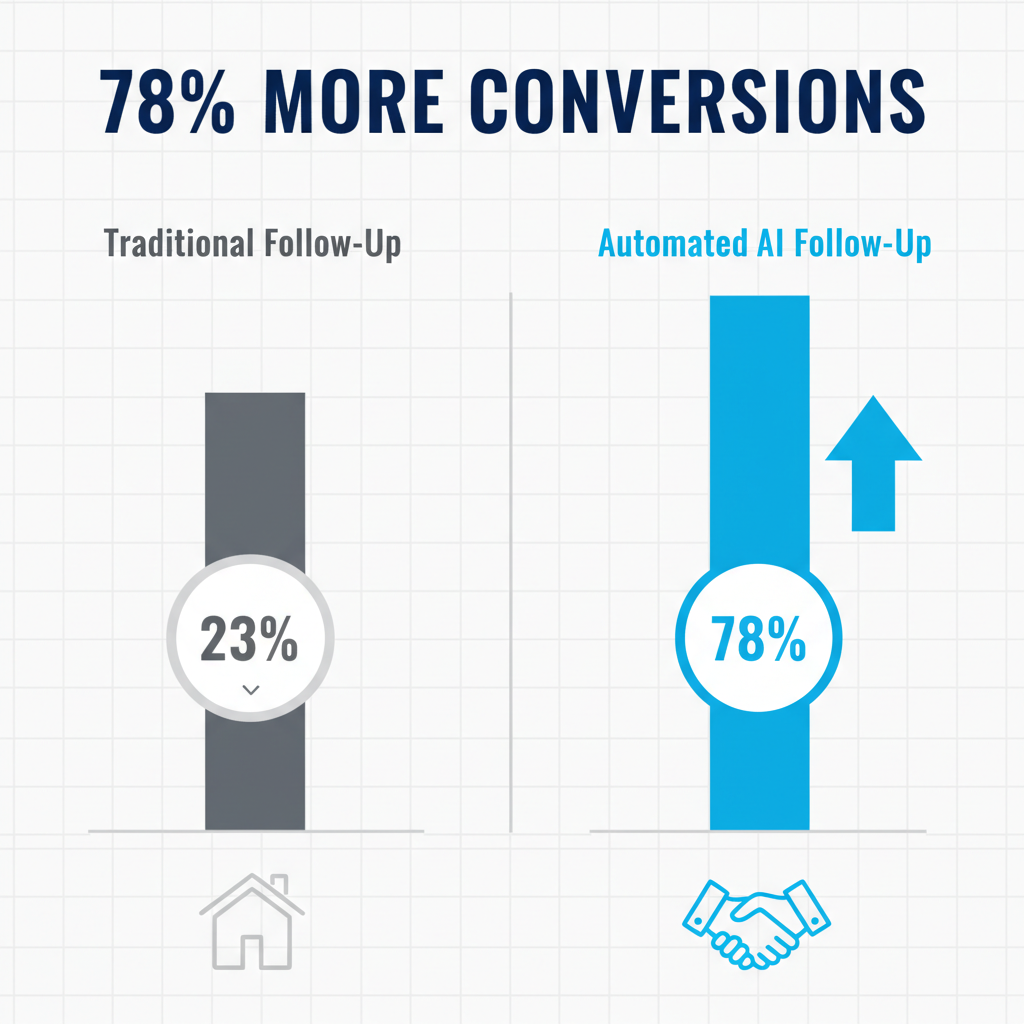
| Follow-Up Consistency | 23% | 100% | 335% increase |
| Lead-to-Appointment | 8% | 13.4% | 67% increase |
| Overall Conversion | 2.3% | 7.1% | 300% increase |
Time and Productivity Gains
Workflow management software powered by AI addresses critical time management
challenges:
Quantified Productivity Benefits:
Administrative Task Reduction: 75% decrease in routine follow-up time
Lead Qualification Efficiency: Process 100+ leads in time for 10-15
manualContent Creation Speed: Personalized content in seconds vs. hours
Appointment Scheduling: 80% reduction in back-and-forth communication
Long-Term Business Growth Impact
Beyond immediate efficiency gains, AI capabilities create compounding benefits:
45% more repeat clients due to consistent communication
60% higher referral rates from superior service delivery
$340,000 additional annual revenue (average team case study)
How Do You Navigate the Risks and Implementation Challenges of AI Automation?
Successful AI implementation requires careful attention to data quality, gradual
rollout strategies, ongoing human oversight, and clear compliance protocols.
Most risks can be mitigated through proper training, backup systems, and
maintaining human decision-making authority.
Data Quality and Privacy Considerations
Essential Data Safeguards:
Data Cleaning and Validation: Ensure CRM data accuracy before AI training
Privacy Compliance: Establish protocols exceeding regulatory requirements
Access Control Systems: Limit AI access to authorized, trained team
membersRegular Security Audits: Quarterly reviews of data security measures
Maintaining Human Oversight and Control
Balance Principle: Successful AI implementations maintain 80/20 rule—80%
automated efficiency for routine tasks, 20% human intervention for complex
situations.
Gradual Implementation Strategies
Recommended Implementation Phases:
| Phase | Timeline | Focus Area | Expected Outcome |
|---|---|---|---|
| 1 | Weeks 1-4 | Basic lead capture/acknowledgment | Faster response times |
| 2 | Weeks 5-8 | Follow-up sequence automation | Improved consistency |
| 3 | Weeks 9-12 | Personalization and multi-channel | Higher engagement |
| 4 | Weeks 13-16 | Advanced analytics and prediction | Optimized conversions |
| Ongoing | Monthly | Continuous optimization | Sustained improvement |
What Does the Future Hold for AI in Real Estate Lead Nurturing?
The future of AI in real estate centers on hyper-personalization, predictive
market analytics, and seamless integration across all customer touchpoints. By
2030, AI systems will anticipate client needs before they're consciously
recognized, while maintaining authentic relationships.
Emerging AI Capabilities in Development:
Market Cycle Prediction: Anticipate local market shifts 6-12 months in
advanceBehavioral Trigger Recognition: Identify subtle client changes indicating
readinessCross-Platform Integration: Seamless data flow between all touchpoints
Voice and Video Analysis: Optimize engagement through communication
pattern analysis
Future Outlook: Industry forecasts suggest that by 2027, 85% of all real
estate interactions will involve some form of AI assistance, making
automation literacy essential rather than optional.
Frequently Asked Questions
What is AI automation in real estate lead nurturing?
AI automation in real estate refers to intelligent systems that automatically
manage lead communication, qualification, and follow-up processes using machine
learning algorithms. These systems send personalized messages, score lead
quality, schedule appointments, and track engagement patterns while maintaining
authentic human communication styles.
How much does implementing AI lead nurturing cost?
AI lead nurturing costs typically range from $200-800 per month for
comprehensive platforms. Initial setup may require additional investment in data
cleanup and training ($500-2,000), but the average agent saves 40+ hours per
week and increases conversion rates by 200-300%, resulting in significant net
profit improvements.
Will AI automation make real estate agents obsolete?
No, AI automation enhances rather than replaces real estate agents. The
technology handles repetitive administrative tasks, allowing agents to focus on
relationship building, complex negotiations, and strategic guidance that require
human expertise. NAR's 2025 survey shows 82% of clients respond positively to AI
integration when it improves service quality.
What are the main risks of using AI for lead nurturing?
Primary risks include data privacy concerns, over-automation leading to
impersonal communication, technical failures, and compliance issues. These are
mitigated through proper data security, human oversight for complex situations,
backup systems, and ensuring all AI communication meets legal and ethical
standards.
How quickly can agents expect to see results?
Most agents see initial improvements within 30 days, with significant results
typically appearing within 90 days. Early benefits include faster response times
and consistent follow-up, while deeper improvements like increased conversion
rates develop over 3-6 months as systems learn patterns.
What types of real estate professionals benefit most?
AI lead nurturing provides greatest benefits for agents handling 50+ leads
monthly, teams looking to scale without proportional staff increases, and
professionals in competitive markets where response speed matters. Both new and
experienced agents see value in systematic follow-up processes.
How does AI integrate with existing CRM and MLS systems?
Modern AI platforms integrate with popular CRM systems (Salesforce, HubSpot,
Chime) and MLS databases through APIs and data synchronization tools.
Integration typically involves connecting data sources, mapping fields, and
establishing automated workflows with minimal disruption to existing processes.
Ready to transform your real estate lead nurturing strategy? Join the growing
number of successful agents leveraging AI automation to increase conversions,
save time, and build stronger client relationships. Schedule a complimentary
30-minute consultation with US Tech Automations to discover how AI-powered lead
nurturing can transform your business.
Tags
About the Author
12+ years in real estate technology optimization and AI implementation